Smith Machine Hip Thrust: Setup, Form and Bar Height
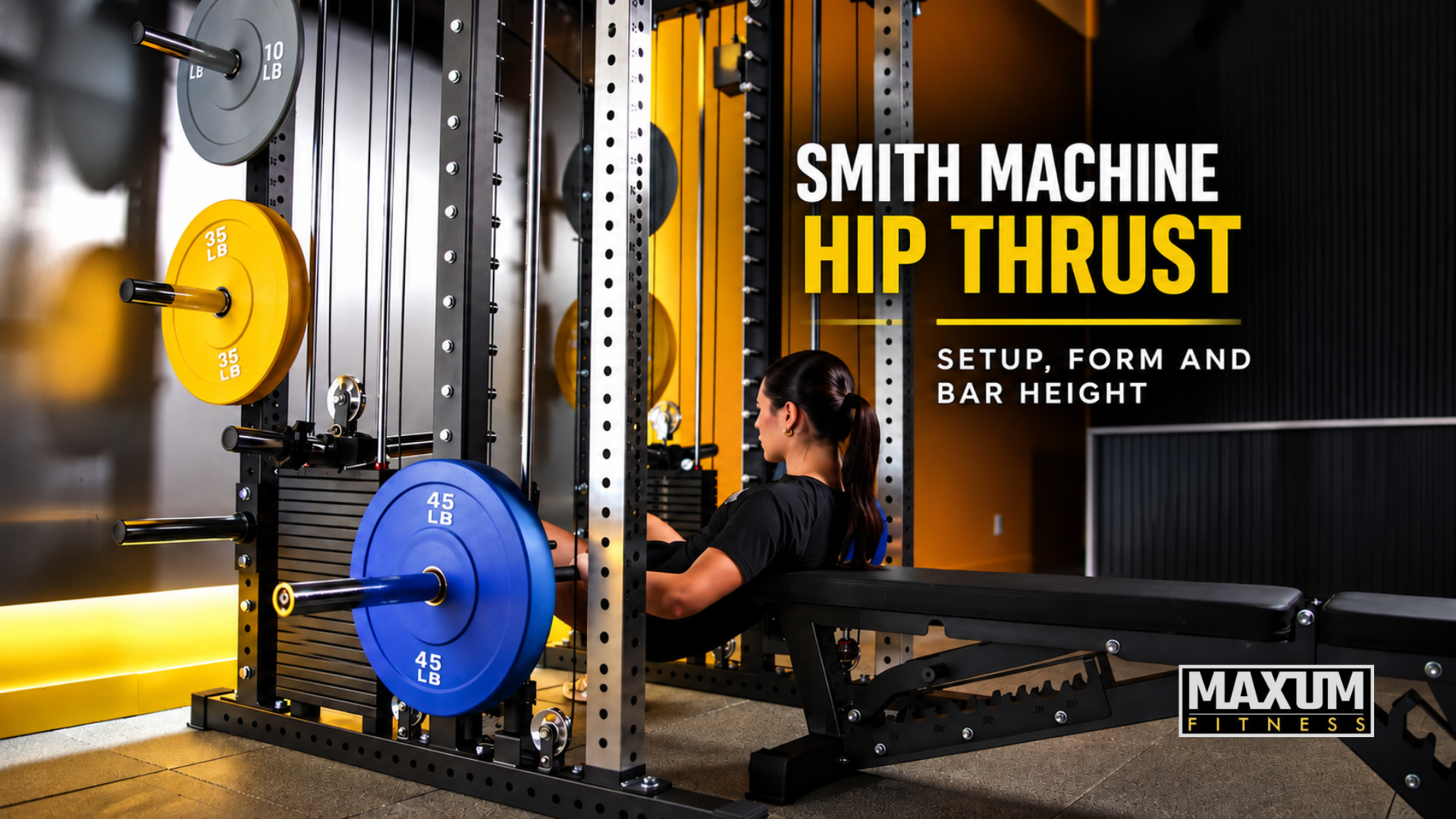
A Smith machine hip thrust is a hip thrust done with the bar locked into guide rails. You sit on the floor with your upper back against a bench, rest the bar across your hips, and drive it up with your glutes, with help from your hamstrings. Because the bar runs on rails, you never have to roll a loaded barbell over your legs or balance it during the set, and you can rotate it back onto the hooks at any point if a rep stalls.
There’s one catch most guides skip: the bar has to get low enough to sit on your hips while you’re on the floor. Plenty of Smith machines can’t do that, so that’s where we’ll start.
Can you do hip thrusts on a Smith machine?
Yes, as long as the bar lowers far enough to rest across your hips while you sit on the floor against a bench. On many Smith machines it can’t, because a cross member at the base of the rack stops the bar short.
That’s a design choice, not a law of physics. The MAXUM X3 uses a flatfoot rack design that lets its Smith bar drop to 11″ (measured from the floor to the underside of the bar), a low position MAXUM specifically calls out for hip thrusts. Some Smith machines built into bolt-down racks can’t get that low because of the lower cross member, so it’s worth checking before you buy.
To check a machine, whether you’re shopping or already own one, sit on the floor with your back against the bench and measure from the floor to the top of your hips at the hip crease, then add the thickness of your barbell pad. Compare that number with the machine’s lowest bar height measured to the underside of the bar, not its centreline, because the underside is what rests on the pad. The bar needs to reach that number or lower. If it isn’t, you can raise yourself instead of lowering the bar: sitting on a stack of firm rubber mats or a low platform, with your feet raised to the same height, closes a small gap.
How do you do a hip thrust on a Smith machine?
Set the bar on a low hook, sit on the floor with your upper back against a bench, and slide in until the padded bar sits over your hip crease. Plant your feet about shoulder-width apart, drive your hips up until your shoulders, hips and knees form a straight line, squeeze your glutes, then lower under control.
- Set the bar height. Before you get underneath, put the Smith bar on the lowest hook position that still clears your hips when you’re seated.
- Set up the bench. Place a flat bench inside the machine with its long side parallel to the bar. Sit on the floor with your upper back against the edge of the bench, just below your shoulder blades.
- Position the bar. Wrap the bar with a barbell pad (one comes with the X3) and slide your legs underneath until the pad sits directly over your hip crease, not your stomach.
- Set your feet. Plant your feet flat on the floor about shoulder-width apart, far enough forward that your shins are close to vertical when your hips are fully extended.
- Warm up with the empty bar. Do a light set with no plates to dial in your pad and foot position before you add any weight.
- Unrack and thrust. Brace your core, lift your hips just enough to rotate the bar off the hooks, and drive through your heels until your hips are fully extended and your torso is roughly parallel to the floor.
- Squeeze at the top. Pause for about a second and squeeze your glutes. Keep your ribs down and your chin slightly tucked.
- Lower with control. Lower your hips until they’re just above the floor, then go straight into the next rep.
- Re-rack. At the end of the set, or any time a rep stalls, rotate the bar back onto the nearest hook before you slide out.
Why do a hip thrust on a Smith machine instead of with a barbell?
Setup is faster and safer, especially when you train alone. With a free barbell you have to roll the loaded bar over your thighs, keep it centred through the set, and work it off your hips at the end. On a Smith machine the rails handle all of that: the bar stays aligned over your hips, every rep follows the same path, and you can re-rack at almost any height if a rep stalls.
The tradeoff is that the rails lock the bar into a straight vertical path. Most lifters adapt to that quickly on hip thrusts, but if the bar feels like it’s pushing you toward or away from the bench, adjust where your back sits on the bench or where your hips sit under the bar until the movement feels natural.
Where should your feet go for a Smith machine hip thrust?
Place your feet about shoulder-width apart, with your heels far enough from the bench that your shins are close to vertical when your hips are fully extended. This position keeps the movement focused on your glutes. If your feet are too close, you’ll tend to feel it more in your quads. If they’re too far away, your hamstrings may take over. Use your empty-bar warm-up set to adjust your foot position until you feel your glutes doing most of the work.
How much weight should you start with?
It depends more on your machine than on you, because Smith machine bars don’t all weigh the same. A counterbalanced bar can feel almost weightless, while a bar without a counterbalance is about as heavy as an Olympic barbell before you add a single plate. On every MAXUM Smith machine, the bar weighs 48 lb: a 45 lb bar plus its mounting brackets. On the X3 and SX2, a removable counterbalance brings that down to 8.6 lb. The S-150 and S-92 have no counterbalance, so you start at the full 48 lb.
Check your machine’s bar weight before your first set, start with the bar alone, and add plates only once you can pause at the top for a full second on every rep without your lower back taking over. Whatever you lift, log the bar weight along with the plates so your numbers stay comparable from machine to machine.
What mistakes should you avoid on a Smith machine hip thrust?
The most common mistakes are arching your lower back at the top, pushing through your toes instead of your heels, setting the bar on your stomach instead of your hip crease, and placing your feet too far out. Each one moves the work away from your glutes.
| Mistake | What you’ll notice | The fix |
| Arching your lower back at the top | You feel it in your lower back, not your glutes | Finish by squeezing your glutes; keep your ribs down and chin tucked |
| Pushing through your toes | Your heels lift and your quads burn | Plant your heels; walk your feet out slightly |
| Bar on your stomach | Uncomfortable, and the rep feels short | Move the pad down to your hip crease |
| Feet too far out | Hamstrings cramp | Bring your feet in until your shins are near vertical at the top |
Which Smith machine is best for hip thrusts?
For hip thrusts, the spec that matters most is how low the bar goes, followed by how much the bar weighs. Of MAXUM’s Smith machines, the X3 is the strongest pick because it combines both. Its bar drops to 11″, tied for the lowest of the four machines we measured, and its counterbalanced bar starts at just 8.6 lb. The S-92 gets just as low, but its 48 lb bar has no counterbalance.
| Model | Lowest bar height* | Bar weight | Counterbalanced? |
| X3 | 11″ | 8.6 lb counterbalanced / 48 lb without | Yes (removable) |
| SX2 | 13″ | 8.6 lb counterbalanced / 48 lb without | Yes (removable) |
| S-150 | 13 1/4″ | 48 lb | No |
| S-92 | 11″ | 48 lb | No |
*Measured in the MAXUM showroom, from the floor to the underside of the bar at its lowest position.
The S-92 matches the X3’s 11″ bar height, which makes it a solid lower-cost option if you’re comfortable starting at 48 lb. The SX2 sits a little higher at 13″ but has a counterbalanced bar, so you can start light. The S-150 has the highest low position of the four at 13 1/4″, along with a 48 lb bar. Before buying any machine for hip thrusts, compare its lowest bar height against your own seated hip height using the measurement described above.